
Dear Reader,
Every January, I watch the same ritual happen across the country. Dentists get together at CE events, study clubs, masterminds, or even just over text threads, and the brag sheets come out.
“How’d you finish the year?”
“We broke $1.3 million.”
“I hit my highest month ever in October.”
“Hygiene was slammed.”
“I produced more implants than any previous year.”
And look, there’s nothing wrong with celebrating wins. You work hard. You should feel proud of the results. But I’m going to tell you something that very few people in your circle will say out loud:
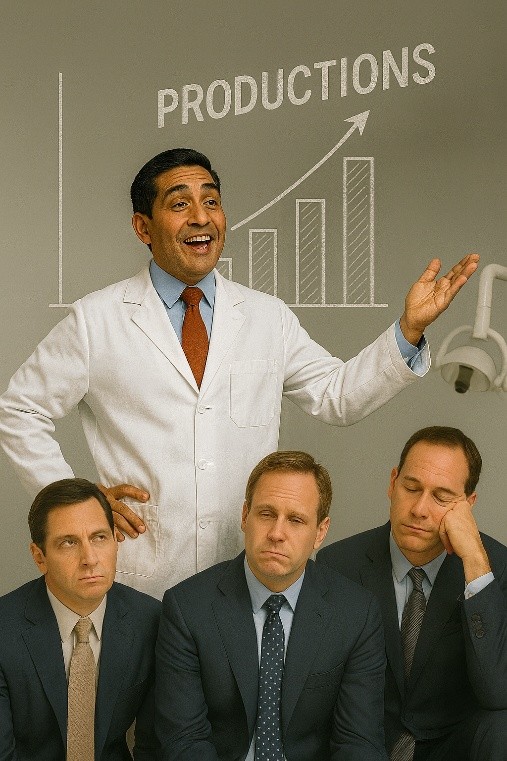
Buyers don’t care about your production the way you think they do.
They don’t assign value to the number of crowns you prepped last year. They’re not impressed because you broke a personal record. They’re not blown away because your schedule is packed or your chair time is maxed out.
Why? Because production tells them nothing about whether the practice can survive without you. And that is the only thing a buyer is truly buying.
Let me put it this way. You could produce $1.5 million last year and still have a low-value practice. And you could have another doctor down the street produce $900,000 and walk away with a much higher valuation.
Not because they’re better than you, smarter, or luckier. But because they built something you didn’t focus on: transferable value.
Production fills the Current Bank. Structure fills the Future Bank. And those are two completely different games.
When I sit down with a buyer and review a practice, production rarely comes up first. In fact, it usually doesn’t come up until we’ve covered the real questions that determine whether a practice will earn a premium or a discount.
Here’s what they look at long before they glance at last year’s production totals:
Is hygiene recurring and stable?
Not busy, predictable. Consistent. Reliable revenue that shows patient loyalty and disciplined scheduling.
Does the team drive case acceptance, or does the doctor?
If you’re the only one convincing patients to move forward, a buyer knows that disappears when you do.
Is the case mix healthy?
Are you doing dentistry that translates into long-term profitability, or is everything running through drill-and-fill transactional work that evaporates instantly?
Can a second provider step in and succeed?
Not hypothetically, actually. Is there room? Systems? Demand? Infrastructure?
Now notice something: none of that has to do with how many crowns you delivered last quarter.
Because here’s the part that shocks a lot of doctors: production can hide weakness.
A high-producing doctor can make a fragile practice look strong. You can outrun inefficiencies, compensate for the lack of systems, and mask weak case acceptance simply by hustling harder.
But to a buyer, high personal production is often a warning sign, not a selling point. It tells them the practice’s success may be propped up by one person’s intensity, charm, speed, or stamina. And buyers don’t buy stamina. They don’t buy your personality. They don’t buy your energy levels. They don’t buy your relationships with long-time patients.
They buy infrastructure, consistency, and a machine they can operate without rebuilding it from scratch.
One of the most memorable cases in my career was a doctor who told me proudly, “Stan, no one can outproduce me.” And he wasn’t wrong. He was a force, clinical, focused, highly skilled. But when he went to market, he was shocked when the offers came in far lower than expected.
He had built a great job for himself, but never built a business someone else could run.
On the other side of the spectrum, I worked with a practice where the owner wasn’t producing anything flashy. No huge implant numbers. No big-ticket cosmetic cases. Just solid dentistry with a razor-sharp structure. Hygiene was dialed. Team-run operations were air-tight. Systems were documented. Case acceptance didn’t depend on the doctor’s charisma. The associate model was already tested and working.
Guess which practice sold for more? The one with less production.
Because the buyer wasn’t buying production. They were buying confidence, predictability, and the ability to step in and inherit something that wasn’t going to crumble the moment the seller drove away.
This is the part of the conversation where dentists usually say, “So you’re telling me production doesn’t matter?” Of course it matters. It matters for your income. It matters for growth. It matters for the health of the practice.
But when it comes to valuation? Production is just one ingredient, and nowhere near the most important one.
What matters is how much of your revenue is recurring. How much of your workflow is team-driven. How much of your case acceptance is systemized. How much of your practice can be duplicated by someone who isn’t you. And January is the perfect time to look at what actually increased your practice value last year… and what didn’t.
Not how much dentistry you personally completed, but how much dentistry your practice can deliver without you driving every step. Not how full your schedule was, but how consistent your case acceptance is across the team. Not how impressive your production numbers look today, but whether a buyer would believe those numbers will still be there tomorrow.
Because what really increases practice value isn’t production—it’s the confidence a buyer has in the practice’s ability to repeat success without depending on the owner.
If you want 2026 to be different, this is where you start.
Build something that lasts. Build something someone else can run. Build something worth buying. Production pays the bills. But structure buys your freedom.
To your success,
Your Team at Everything DSO