
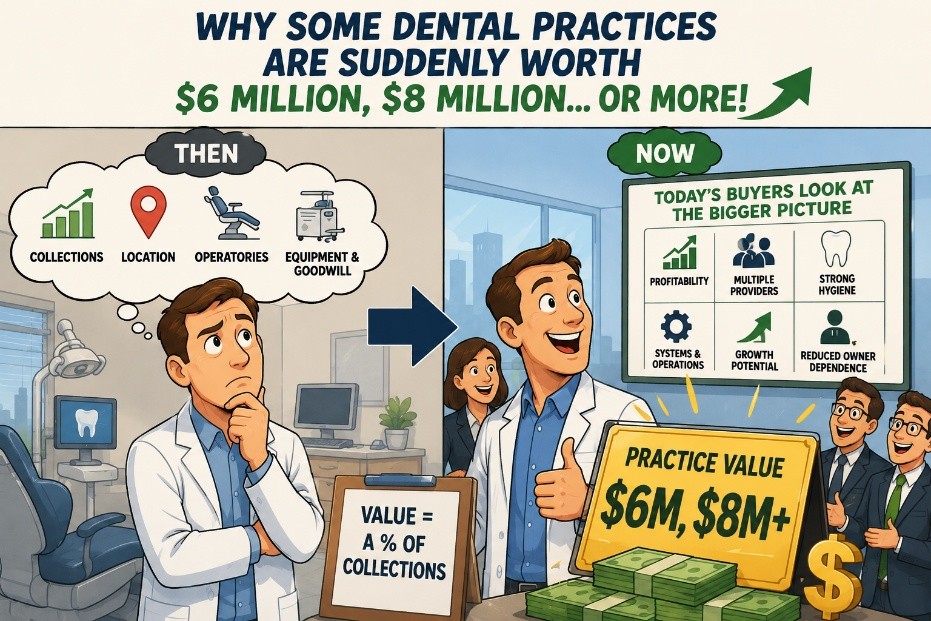
Not long ago, if you asked most dentists what determined the value of a practice, the answer was usually pretty simple. Collections, location, number of operatories, maybe equipment and goodwill. For years, that was largely how many practices were evaluated. But in today’s environment, especially with DSOs and private equity groups aggressively competing for the right opportunities, the conversation has changed dramatically.
I recently reviewed a situation involving a multi-location dental practice collecting roughly $4.2 million annually. On paper, it looked like a strong practice, but not necessarily the kind of business most dentists would assume commands a massive valuation. The owner was doing well, had a good team, and had built a stable operation over time. But what happened next surprised even many people inside the industry.
The practice ultimately received a valuation approaching nearly $7 million. That number tends to stop people in their tracks because many dentists still think in terms of collections-based valuations. They see a practice collecting four million dollars and assume maybe it sells for four million dollars, give or take. But that’s not how sophisticated buyers are looking at practices anymore.
Today’s buyers are increasingly focused on EBITDA. That’s simply a way of measuring profitability and operational performance after normalizing expenses and removing certain owner-specific items. It may sound like financial jargon, but the concept itself is actually pretty simple. Buyers want to know how profitable and scalable the business truly is if it continues operating beyond the current owner.
In this particular case, the practice had several characteristics that sophisticated buyers love. It had multiple providers, healthy hygiene production, stable management, strong systems, and importantly, the business was not completely dependent on the owner personally producing all the dentistry. That last point matters more than many dentists realize.
When buyers see a practice that can continue operating smoothly without the owner carrying the entire operation on their back, risk goes down considerably. Lower perceived risk often leads to stronger multiples and higher valuations. Buyers are willing to pay premiums for predictability because predictable businesses are easier to scale and grow.
Another important factor was infrastructure. The practice already had many of the operational pieces larger organizations look for when evaluating acquisition opportunities. Reporting systems, staffing structure, operational consistency, and growth potential all made the practice more attractive. In many ways, the doctor had unintentionally built the kind of business larger buyers actively compete for today.
This is where many practice owners get confused. Two practices can collect similar numbers and still receive dramatically different valuations. One practice may look busy and successful on the surface but remain heavily owner-dependent with operational inefficiencies hiding underneath. The other may have cleaner systems, stronger profitability, healthier hygiene, and a structure that buyers believe can grow long after the owner exits. Those differences matter tremendously in today’s market.
Another piece many dentists are now hearing about is rollover equity. Some modern DSO deals are no longer just simple “cash at closing” transactions. In certain situations, doctors retain a portion of ownership in the larger organization after the sale. That creates the possibility of participating in future growth or recapitalization events later down the road.
Now, to be clear, not every deal is structured that way and not every practice qualifies for these kinds of opportunities. But it does illustrate how sophisticated dental transitions have become over the last several years. These are no longer simple handshake deals between two local dentists. Many transactions today resemble middle-market business acquisitions with investment groups, strategic growth planning, and long-term operational modeling involved behind the scenes.
What I find interesting is that many dentists still underestimate the value hidden inside their own practices. Sometimes a doctor has spent years quietly building strong systems, stable teams, and operational consistency without realizing buyers may view those things as tremendously valuable. Other times, dentists focus entirely on production while overlooking the operational weaknesses that quietly reduce value.
That’s why understanding what buyers actually value has become so important. Because the practices commanding extraordinary numbers today are usually not accidental. They are businesses built with stability, infrastructure, and long-term scalability in mind — whether the owner realized it at the time or not.
If you enjoyed what you just read, I’d encourage you to explore the DG&E Newsletter, where we go much deeper into practice growth, profitability, DSOs, transitions, valuation trends, and the changing business side of dentistry. There’s a wealth of practical insight designed specifically for dentists trying to build smarter, more valuable practices. Click Here and enjoy your first free issues on us.
To your success,
Stan Kinder
and Your Team at Everything DSO