
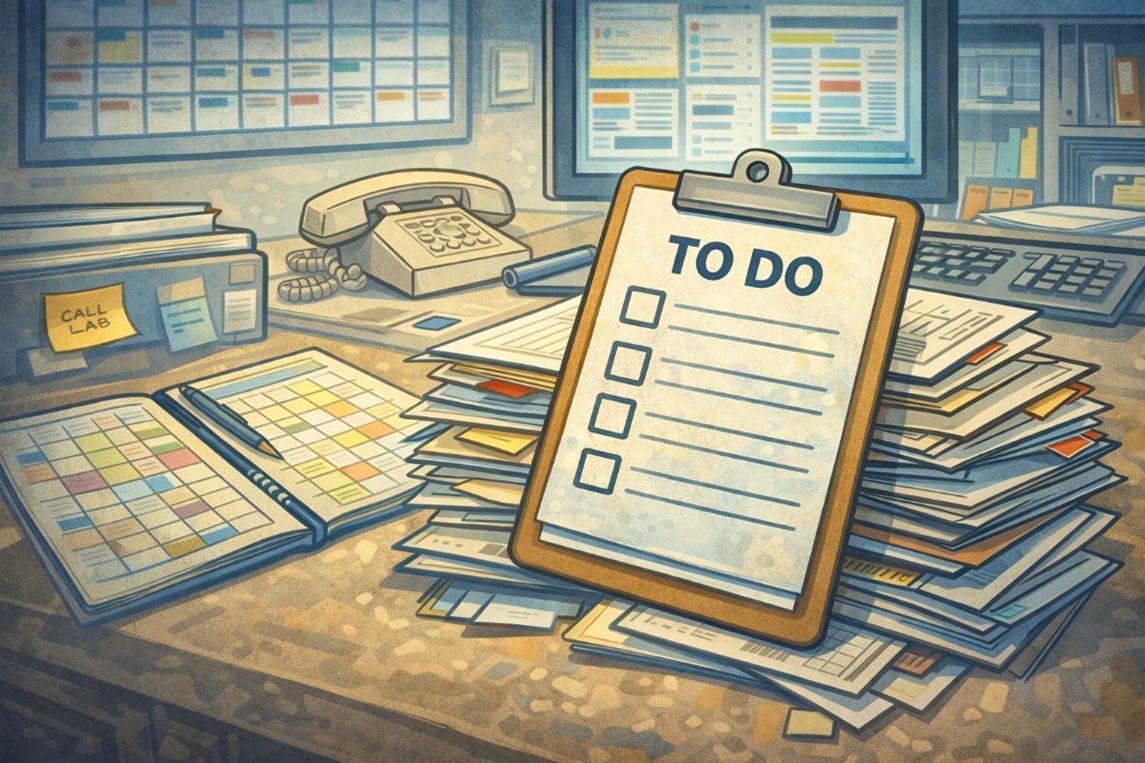
Most practices don’t struggle because the team isn’t working hard. They struggle because certain types of work never get done. Not ignored. Not avoided. Just delayed long enough that they quietly disappear.
On any given day, the schedule is full, patients are being seen, and the team is moving from one task to the next. The focus is on what is immediately in front of them, which makes sense because that’s what feels most urgent.
But not all important work shows up as urgent and that is where the gap begins.
Across professional services, studies of productivity consistently show that a significant portion of meaningful work is delayed because it lacks a defined moment for completion. It sits between tasks, waiting for someone to return to it when there’s time.
In most practices, that time never comes.
Think about the types of work that tend to fall into this category.
- Unscheduled treatment plans that need follow-up.
- Insurance claims that require additional attention.
- Patients who said “not right now” but did not say no.
- Internal systems that need refinement but never make it to the top of the list.
None of these items create immediate pressure. There’s no patient in the chair waiting for them. No deadline that forces action. No interruption that demands attention.
So they wait. And over time, that waiting becomes loss.
Research on follow-up and task completion shows that response time plays a significant role in outcomes. The longer a task sits without action, the less likely it is to be completed. In sales and service environments, delays in follow-up can reduce conversion rates dramatically, not because interest disappears, but because momentum does.
The same pattern applies in dentistry.
A patient who leaves without scheduling is far more likely to delay indefinitely if there is no timely follow-up. A claim that’s not addressed quickly is more likely to age, become more complicated, or be written off. A system that’s not improved continues to create small inefficiencies that compound over time.
None of these losses are obvious on their own.
Together, they can represent a meaningful portion of unrealized revenue and unnecessary friction inside the practice.
The challenge isn’t effort. Its structure.
When work lacks a clearly defined place in the day or the week, it competes with everything else that feels more immediate. The result is that only urgent tasks consistently get completed, while important tasks are postponed.
High-performing practices tend to approach this differently.
They create dedicated time and clear ownership for the work that does not naturally demand attention. Follow-up is not something that happens “when there is time.” It is part of the process. Outstanding items are tracked, not remembered. Responsibilities are assigned, so nothing sits in a shared space where everyone assumes someone else will handle it.
This does not require more hours. It requires intention around how time is used.
Even small improvements in this area can produce measurable results. Increasing follow-up consistency, reducing aging accounts, and converting previously unscheduled treatment into completed care can have a direct impact on production and cash flow without increasing patient volume.
It also reduces stress.
When important work is consistently addressed, the practice feels more controlled. Fewer issues linger in the background, and the team spends less time reacting to problems that could have been resolved earlier.
From a growth perspective, this creates stability. From an exit perspective, it becomes even more valuable.
Buyers are not just evaluating revenue. They are evaluating how well the practice captures the opportunities already within it. A practice that consistently follows through signals discipline, reliability, and strong operational systems.
A practice where important work routinely falls through the cracks suggests untapped potential, but also introduces uncertainty about how much effort will be required to realize it.
That difference influences both interest and valuation.
Most practices don’t need more opportunity. They need to capture more of the opportunity they already have. And in many cases, that comes down to the work that never quite makes it onto the schedule.
If you found this helpful and want to better understand how decisions like this impact growth, valuation, and long-term options, you may want to take a closer look at the Dental Growth and Exit Newsletter. CLICK HERE for more details.
To your success,
Your Team at Everything DSO