
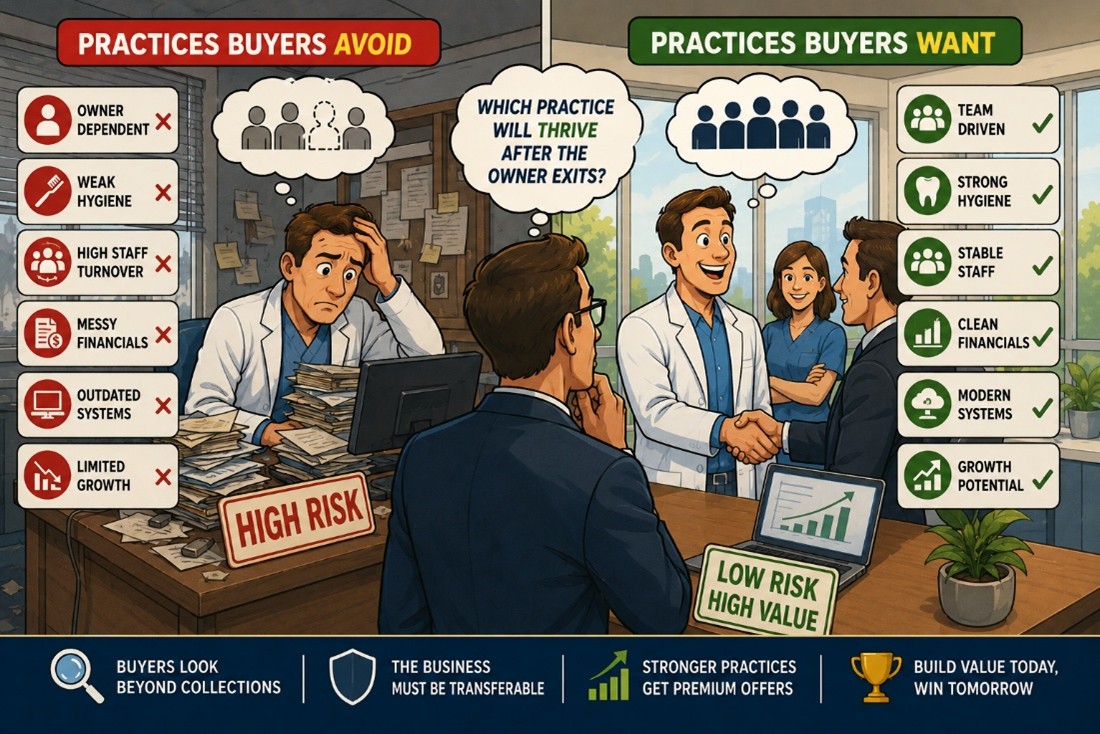
One of the biggest misconceptions in dentistry right now is the belief that every practice will automatically attract strong buyers simply because dentistry itself remains a desirable industry. While it is true that DSOs and private equity groups continue pursuing acquisitions aggressively, the reality is that buyers have become far more selective than they were several years ago. And in 2026, some practices are quietly becoming much harder to sell at premium valuations.
That does not mean these are “bad” practices. In many cases, they are offices built by hardworking doctors who spent decades caring for patients and earning excellent livings. But buyers today are evaluating practices differently than owners often do. They are not simply asking whether the doctor worked hard or collected strong revenue. They are asking whether the business itself can continue growing successfully after the owner steps away.
One of the biggest red flags buyers see today is excessive owner dependence. If nearly all production, patient relationships, leadership decisions, and operational knowledge live inside one doctor’s head, buyers immediately recognize risk. Even highly productive practices can receive lower valuations if the organization feels difficult to transfer successfully after the owner exits.
Another issue buyers pay close attention to is hygiene performance. Strong hygiene departments create recurring revenue, improve patient retention, and often indicate healthier long-term practice stability. Weak hygiene systems, inconsistent recare, or declining patient retention trends can quickly raise concerns during due diligence because buyers view those issues as indicators of deeper operational weaknesses.
Staffing instability has also become a much bigger concern than many dentists realize. Buyers carefully study turnover, team structure, and operational consistency because unstable staffing environments often create future profitability problems. A practice may still appear busy on the surface while internally struggling with burnout, inefficiency, and operational inconsistency that buyers immediately recognize.
Financial organization matters tremendously as well. Clean reporting, organized financials, and clear operational visibility create confidence for buyers. Messy bookkeeping, inconsistent reporting, unexplained expenses, or unclear profitability trends can slow deals down quickly or reduce buyer enthusiasm entirely. Sophisticated organizations want clarity because uncertainty increases perceived risk.
Technology and infrastructure also play larger roles in valuation conversations now. Buyers increasingly prefer practices with modern systems, organized workflows, digital integration, and scalable operational infrastructure already in place. Outdated systems may not kill a deal entirely, but they often create additional concerns about future investment requirements after acquisition.
Another growing issue involves practices with limited growth potential. Buyers love opportunities where they can expand services, improve operations, add providers, strengthen hygiene, or scale production over time. Practices that appear stagnant, operationally maxed out, or overly dependent on the current owner’s personal production often generate less excitement in competitive acquisition environments.
One thing many dentists do not fully realize is that buyers compare opportunities constantly. Your practice is not being evaluated in isolation. It is being evaluated against dozens or even hundreds of other acquisition opportunities competing for the same capital and attention. Buyers naturally gravitate toward practices that appear stable, scalable, organized, and easier to grow long term.
This is where emotional attachment sometimes creates a disconnect for practice owners. Doctors naturally see years of sacrifice, hard work, loyal patients, and personal commitment when they evaluate their practice. Buyers, however, are evaluating operational systems, future cash flow, provider scalability, and transferable infrastructure. Those are two very different perspectives.
The encouraging part is that many of the issues buyers dislike can often be improved long before a transition occurs. Operational systems can be strengthened. Hygiene can improve. Associates can be added. Reporting can become cleaner. Team culture can stabilize. Profitability can increase. In many cases, small strategic improvements made several years before a sale can dramatically impact the eventual outcome.
That is why I often tell dentists that value is rarely created at the closing table. It is usually created quietly over time through better systems, stronger operations, healthier profitability, and reduced dependence on the owner alone. The practices attracting premium buyers today are typically businesses that were intentionally built to function well beyond the doctor personally sitting in the operatory every day.
If you enjoyed what you just read, I’d encourage you to explore the DG&E Newsletter, where we regularly dive deeper into practice growth, valuations, DSOs, operational strategy, transitions, and the changing business side of dentistry. There’s a tremendous amount of practical insight available, and your first free issues are completely on us. Click Here to start exploring.
To your success,
Stan Kinder
and Your Team at Everything DSO