
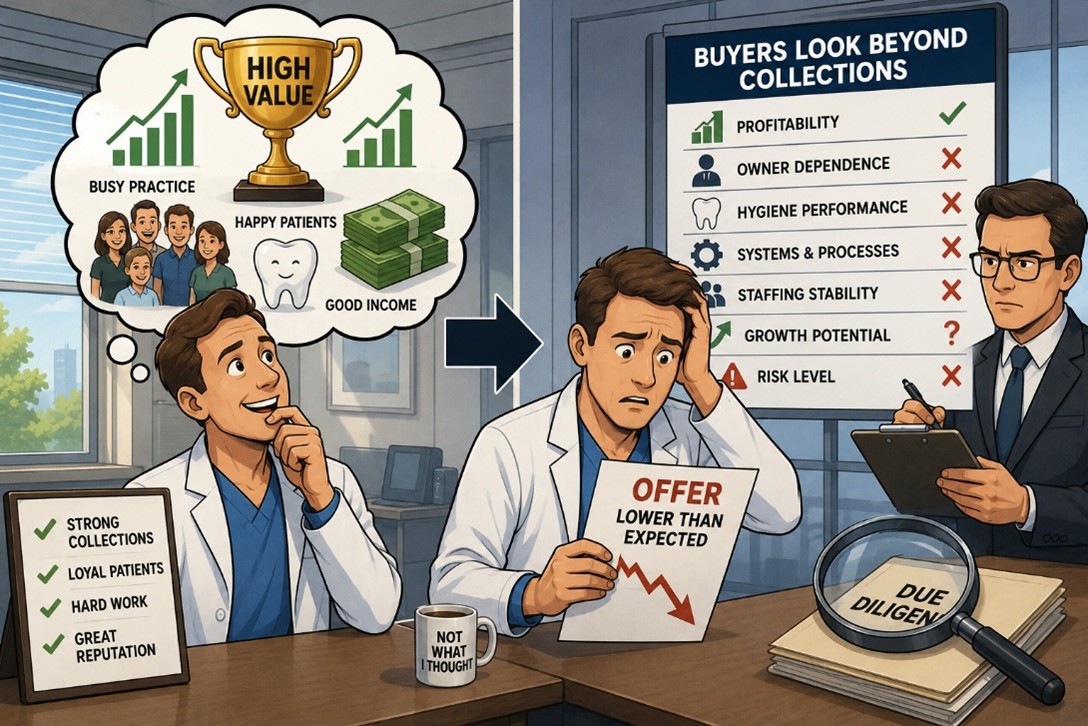
One of the hardest conversations in dentistry today is not about clinical care, staffing, or insurance headaches. It’s the moment a dentist discovers their practice may not be worth nearly what they thought it was. And unfortunately, that situation is becoming more common as buyers become more sophisticated and the market becomes more selective.
For years, many practice owners naturally assumed value was tied mostly to collections and hard work. If the office stayed busy, patients kept coming in, and the doctor made a good living, the assumption was that the practice itself must also be highly valuable. In many cases, that was true to a certain extent. But in today’s DSO-driven environment, buyers are looking much deeper than surface-level production numbers.
I recently spoke with someone involved in a situation that perfectly illustrates this shift. The doctor had spent decades building a practice that produced strong collections year after year. He worked hard, had loyal patients, and believed he had built an extremely valuable asset that would largely fund his retirement. On paper, the practice looked impressive at first glance.
But once buyers began digging into the details, the story started changing quickly. The practice relied heavily on the owner for nearly all production. Hygiene performance had slowly weakened over the years. Systems were inconsistent, staffing turnover had increased, and many operational processes existed mostly inside the doctor’s head instead of being documented and transferable.
The doctor was shocked when the offers came in far lower than expected. In his mind, the practice was worth several million dollars more than what buyers were willing to pay. But the buyers were not evaluating how hard the doctor worked over the last 30 years. They were evaluating future risk.
That distinction is incredibly important. Buyers today are asking a different set of questions than many dentists realize. They want to know whether the business can continue operating successfully after the owner steps away. They want to see operational consistency, stable profitability, provider infrastructure, strong hygiene systems, clean reporting, and opportunities for future growth.
When a practice depends almost entirely on one doctor doing everything, buyers become nervous. Even if collections are strong, the business may feel fragile from an investment standpoint. If the owner leaves, retires, or reduces production, what happens next? That uncertainty often lowers valuations significantly because buyers are trying to reduce operational risk wherever possible.
Another issue many practice owners overlook is profitability. Two practices collecting similar numbers can have dramatically different EBITDA performance depending on overhead, staffing efficiency, hygiene contribution, and operational structure. Buyers today study those numbers carefully because profitability often drives valuation far more than collections alone.
I think this creates an emotional challenge for many dentists because practices become deeply personal over time. The office represents years of sacrifice, long hours, stress, and commitment. Naturally, doctors attach emotional value to what they built. But sophisticated buyers do not evaluate emotion. They evaluate systems, risk, scalability, and future performance potential.
Now, none of this means a practice cannot improve its value significantly before a transition. In fact, many of the weaknesses buyers identify can often be corrected over time with the right planning and operational focus. Hygiene systems can improve. Reporting can become cleaner. Staffing structure can stabilize. Associates can be added. Operational systems can be documented and strengthened.
That’s why I often tell dentists the biggest valuation mistakes usually happen years before the sale itself. The market rarely punishes doctors overnight. More often, small operational issues quietly compound over time until buyers eventually see a business with too much owner dependence and not enough transferable infrastructure.
The good news is that understanding how buyers think gives practice owners the ability to prepare strategically long before they ever decide to transition. Because the dentists receiving premium valuations today are usually not just excellent clinicians. They are owners who intentionally built businesses designed to survive and grow beyond themselves.
If you enjoyed what you just read, I’d encourage you to explore the DG&E Newsletter, where we regularly discuss practice growth, DSOs, profitability, operational strategy, transitions, and the changing economics behind dental practice ownership. There’s a tremendous amount of practical insight available, and your first free issues are on us. Click Here to start exploring.
To your success,
Stan Kinder
and Your Team at Everything DSO