
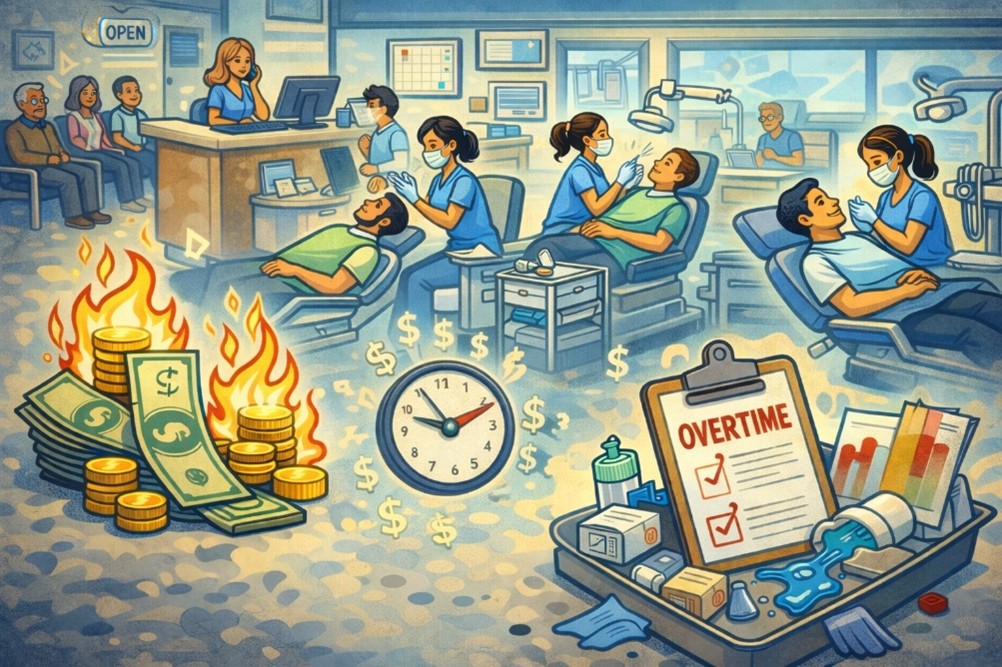
Most practices do not have a marketing problem. They have a capacity problem they don’t recognize.
On paper, the schedule looks strong. Most days are filled. Hygiene is booked out. The team is busy from morning to late afternoon. There are no obvious gaps that suggest something is wrong.
From the outside, it looks like the practice is operating near full capacity.
But “almost full” is not the same as optimized. And the difference between those two states is where a significant amount of lost production hides.
Across service-based businesses, studies of scheduling efficiency consistently show that even small amounts of unused or misused time can reduce overall output by 10 to 20 percent. In dentistry, that loss rarely shows up as empty chairs. It shows up as fragmented time, poorly placed procedures, and missed opportunities to maximize each hour of the day.
A schedule can be full and still underperform.
Consider how time is actually used throughout a typical day.
Short appointments are placed between longer procedures, breaking up blocks of productive clinical time. High-value procedures are scheduled in less optimal time slots, where they compete with interruptions or time pressure. Cancellations create gaps that are filled too late or with lower-value procedures that don’t fully utilize the available time.
Each of these decisions seems minor in isolation.
Together, they shape the entire production capacity of the practice.
Research on time utilization shows that when schedules are structured intentionally, practices can increase production significantly without adding hours or patients. The improvement does not come from working harder. It comes from aligning the schedule with how production is actually generated.
That requires a different way of looking at the day.
Instead of asking whether the schedule is full, high-performing practices ask whether the schedule is productive.
They identify which procedures generate the most value and protect time for those procedures. They build templates that reduce fragmentation and allow the team to move efficiently from one patient to the next. They assign clear responsibility for managing openings, so gaps are addressed quickly and strategically rather than reactively.
This level of structure doesn’t eliminate flexibility. It creates control.
Without it, the schedule becomes a patchwork of appointments that keeps everyone busy but does not consistently produce at the level it could.
That’s where many practices get stuck.
They feel busy, but growth stalls. They add marketing, bring in more patients, and increase activity, but the underlying structure limits how much of that activity turns into production.
At that point, the instinct is often to expand. Add another operatory. Extend hours. Hire additional staff.
Sometimes that’s the right move.
Often, it is an expensive solution to a problem that already exists inside the current schedule.
Improving utilization by even a small percentage can produce meaningful gains. A 10 percent increase in effective chair time across a year can represent a substantial increase in revenue, without increasing overhead in the same proportion.
That kind of improvement is more predictable, more controllable, and often more profitable than simply adding volume.
It also changes how the practice feels on a daily basis.
The team is less rushed. Transitions between patients are smoother. The day flows with more consistency, which reduces stress and improves the overall experience for both patients and staff.
From a growth perspective, this creates a stronger foundation. From an exit perspective, it becomes even more important.
Buyers don’t just look at how busy a practice is. They look at how efficiently that time is used. A practice that produces strong results within its existing structure signals that there is room for additional growth without immediate expansion.
That reduces risk and increases value.
A practice that appears full but underutilized raises a different question. If more patients are added, will the system support that growth, or will inefficiencies limit the upside?
That uncertainty affects how the practice is viewed.
Most owners don’t think of their schedule as a strategic asset. But it is.
It determines how much production is possible within the hours you already work. It influences team performance, patient experience, and long-term scalability. It is one of the few areas where small adjustments can create immediate and measurable impact.
The goal is not to be full.
The goal is to be intentional with the time you already have.
If you found this helpful and want to better understand how decisions like this impact growth, valuation, and long-term options, you may want to take a closer look at the Dental Growth and Exit Newsletter. CLICK HERE for more details.
To your success,
Your Team at Everything DSO