
Doctor,
When dentists talk about exiting their practice, the conversation usually starts with numbers. Sale price. Multiple. Net proceeds. Taxes. That makes sense, you’ve spent years building something valuable, and you want to know what it’s worth.
But what often gets overlooked is the part that matters just as much, sometimes more:
What does your life look like the day after the sale?
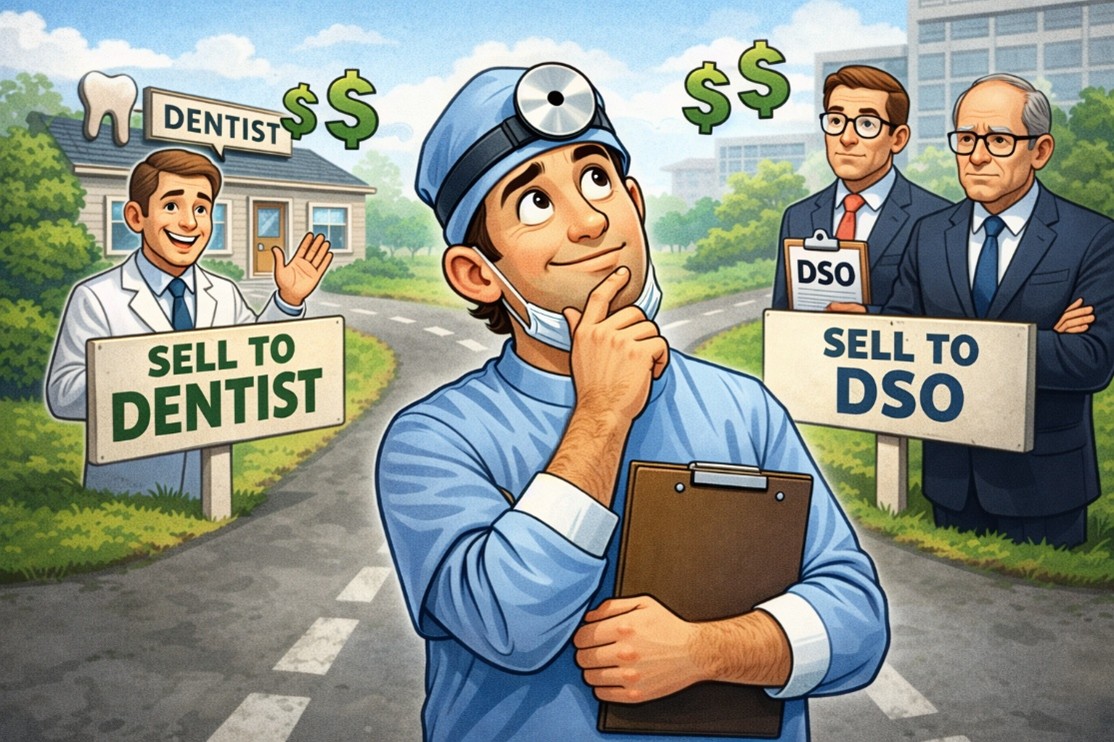
Because selling to a private dentist and selling to a DSO might both be called an “exit,” but they lead to very different realities. And the mistake I see most often is dentists choosing a buyer based on comfort or familiarity without fully thinking through how that choice reshapes their daily life.
Selling to another dentist feels familiar. It feels like passing the torch. You understand their world. They understand yours. The conversations feel natural. The transition often feels personal. Many dentists imagine this path as cleaner, simpler, and less disruptive.
And in some cases, it is.
But it also comes with expectations that don’t always get talked about upfront. When you sell to a private dentist, the transition period often matters a great deal. You’re not just handing over keys, you’re handing over relationships, goodwill, and trust. Patients expect continuity. The buyer often expects mentorship, support, and reassurance. Your presence may be needed longer than you originally planned, because dentistry is personal.
Some doctors enjoy that. Others find it harder than expected to step away.
Selling to a DSO feels very different. The language changes. The structure changes. The timeline is clearer, but so are the guardrails. You’re no longer easing someone into ownership; you’re stepping into a defined role inside a larger organization. For some dentists, that structure is a relief. Decisions are clearer. Expectations are spelled out. There’s less emotional weight around the transition.
But there’s also less autonomy.
Post-sale, your schedule, compensation, and responsibilities are often shaped by agreements that didn’t exist when you owned the practice outright. That doesn’t mean it’s bad; many dentists thrive in that environment, but it does mean your relationship with the practice changes overnight. You go from owner to operator, and that shift hits differently depending on who you are and what you want next.
This is where lifestyle impact becomes the real decision-maker.
Do you want to keep practicing dentistry for a few more years on your terms, easing out slowly, maintaining control over how things are done? Or do you want clarity and finality, even if that means adapting to someone else’s structure for a defined period?
Do you want flexibility, or do you want certainty?
Do you want to remain deeply connected to the practice and its people, or are you ready for a cleaner separation?
Neither choice is inherently better. But they are not interchangeable.
I’ve worked with dentists who sold to private buyers and loved staying involved during the transition. They enjoyed mentoring the next generation, watching the practice continue under new ownership, and gradually redefining their role. I’ve also worked with dentists who underestimated how hard it would be to let go and how emotionally taxing it can be to stay half-in, half-out.
On the other side, I’ve seen dentists sell to DSOs and feel an immediate sense of relief. The weight of ownership lifted. The uncertainty disappeared. They could focus on dentistry without carrying the full burden of the business. And I’ve also seen dentists struggle with the loss of independence, even when the financial outcome was strong.
That’s why this decision isn’t really about which buyer pays more. It’s about alignment.
An exit isn’t a finish line. It’s a transition into a new version of your life. And the buyer you choose plays a major role in shaping that next chapter — your schedule, your stress level, your sense of identity, and your freedom.
The smartest exits I see are the ones where the dentist gets honest early. Honest about how much control they want to keep. Honest about how long they want to keep working. Honest about whether they enjoy mentoring and transition, or whether they’re ready to close the door and move on.
When you make the decision with lifestyle in mind, the numbers tend to fall into place more naturally. When you make it with numbers alone, the lifestyle consequences often come as a surprise.
So if you’re thinking about exit, even if it’s years away, start here. Not with valuation. Not with multiples. With a simple question:
What do I want my life to look like after the sale?
Once you know that answer, choosing between a dentist buyer and a DSO becomes far clearer.
To your success,
Your Team at Everything DSO
If you want ongoing insight into how growth decisions today shape exit options tomorrow, we share that perspective each month in the Dental Growth & Exit Newsletter. CLICK HERE, and the first two months are free.