
Let me tell you about a call I had a few weeks ago.
The doctor gets on the phone, clearly excited. He says, “Stan, we’ve been using AI a lot lately.” You could hear it in his voice—he felt like he was ahead of the curve.
So I asked him a simple question. “What’s it actually doing for your numbers?”
There was a pause. Then he started listing things. “We’re writing better emails. Our social media is more consistent. We’ve got some automated responses set up.” All good things. None of them moved the number in any meaningful way.
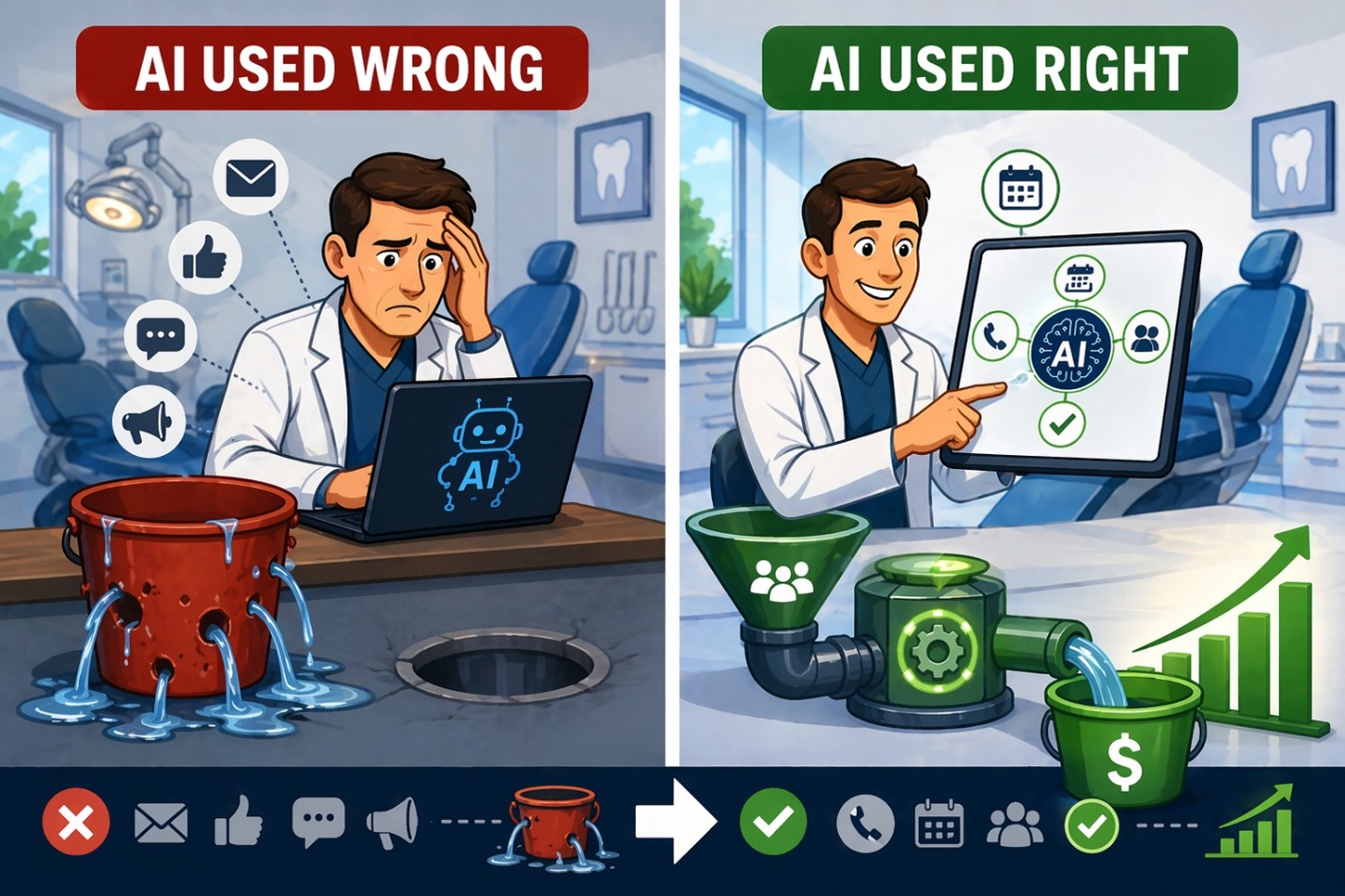
And that’s where most practices are right now. They’re using AI… but they’re using it in places that don’t really matter.
Look, I’m not against better emails or cleaner marketing. That stuff has its place. But if that’s where AI starts and stops in your practice, you’re missing the real opportunity. Because AI is not a marketing tool. It’s an operational tool.
The difference matters more than most people realize.
Marketing might get someone in the door. Operations determine whether they say yes, whether they come back, and whether they refer other patients. That’s where revenue is actually created. And that’s where most practices are still weak.
I’ve looked at enough practices to know this pattern. The doctor believes marketing is the problem because growth feels inconsistent. So they invest in ads, content, or agencies, hoping more leads will fix it.
But when you look closer, the issue isn’t leads. It’s what happens after the lead shows up.
Patients call and don’t get scheduled. Treatment gets presented but not followed up on. Someone says, “I’ll think about it,” and no one circles back in a structured way. That’s not a marketing problem. That’s a system problem.
Now here’s where AI should be focused. It should be tracking those interactions. It should be triggering follow-up automatically. It should be making sure no patient falls through the cracks simply because someone forgot, got busy, or assumed someone else handled it.
That’s where the leverage is.
When follow-up becomes consistent, case acceptance improves. When communication becomes structured, patient trust increases. When nothing slips through the cracks, revenue stabilizes. And once revenue stabilizes, everything else gets easier.
But most practices never get there because they’re distracted by the surface-level uses of AI.
It’s easy to see a better email. It’s easy to feel like your marketing looks more polished. It’s much harder to dig into your operations and admit that there are leaks in the system.
AI exposes those leaks. And that’s uncomfortable for a lot of people. Because once you see that patients aren’t being followed up with consistently, or that scheduling inefficiencies are costing you money, you can’t blame the market anymore. You can’t blame the economy or competition.
You have to fix the system. That’s where the real work is.
Now, here’s the upside. When you apply AI to operations instead of just marketing, the improvements are measurable. You can see the increase in scheduled appointments. You can track how many patients re-engage. You can measure how case acceptance changes over time.
That’s real leverage. And it doesn’t require more effort—it requires better structure.
This is also where valuation starts to shift. Buyers don’t care how good your Instagram looks. They don’t pay more because your emails sound polished. They care about how the business runs and how predictable the revenue is.
If your systems are tight, if your follow-up is consistent, and if your numbers reflect that, your practice becomes more valuable. If not, it doesn’t.
That’s why this matters.
The practices that figure this out early start to separate themselves. Not because they’re doing more, but because they’re doing the right things better. Their operations are cleaner, their revenue is more consistent, and their reliance on guesswork starts to disappear. And when that happens, growth becomes easier to control.
So if you’re using AI right now, take a step back and ask yourself one question. Is it making your practice look better… or run better? Because those are two very different outcomes. And only one of them moves the number.
If this made you rethink how you’re using AI in your practice, there’s more where this came from.
CLICK HERE to register for the DG&E Newsletter and get your first three issues free. If you like what you just read, you’ll get practical, no-fluff insights like this every month—focused on growth, control, and exit value.
Or, if you’re already thinking about what the next 1 to 5 years look like, don’t wait.
Reach out to me directly.
Stan Kinder 703-298-1690
We’ll take a clear look at where you are, what the numbers actually say, and what needs to change to give you more control over the outcome.
Because clarity creates leverage.
To your success,
Stan Kinder
and Your Team at Everything DSO