
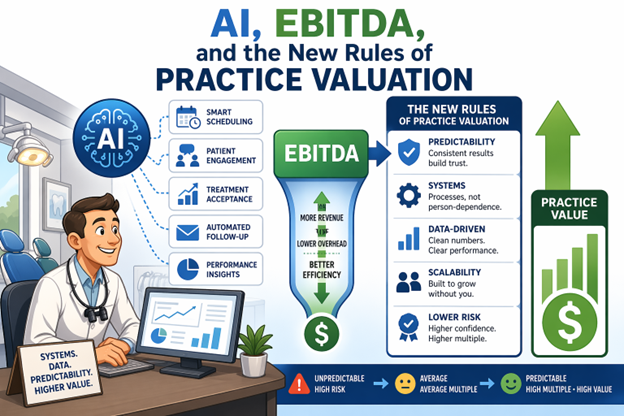
Let’s talk about something that actually moves the number.
Not production. Not how busy your schedule looks. I’m talking about EBITDA, because that’s what buyers use to determine what your practice is worth. And right now, AI is starting to change how that number is built, how it’s evaluated, and how much someone is willing to pay for it.
Most dentists don’t spend much time thinking about EBITDA until they’re getting close to selling. This is a mistake.
Because EBITDA isn’t just a number you calculate at the end. It’s the result of how efficiently your practice runs every single day. Revenue, overhead, systems, consistency—all of it feeds into that one number. And that number drives your multiple.
Now here’s where things are shifting. Traditionally, two practices could have similar EBITDA and still be valued differently based on risk. If one practice looked stable and predictable, it would command a higher multiple. If the other looked inconsistent or overly dependent on the owner, it would be discounted. That hasn’t changed.
What has changed is how quickly that perception can move. AI is accelerating improvements in the exact areas that impact EBITDA. Not in theory—in very practical, measurable ways. It tightens revenue, reduces waste, and improves consistency across the board.
Let’s start with revenue. Most practices have leakage. Patients who don’t schedule, treatment that doesn’t get accepted, follow-up that never happens. It’s been accepted as part of the business because tracking it has always been difficult.
AI changes that. It tracks behavior, triggers follow-up, and keeps patients engaged beyond the chair. It doesn’t rely on memory or manual effort, which means fewer missed opportunities. Over time, that alone can significantly increase realized revenue without adding new patients. That’s the first lever.
Now look at overhead. Labor is the biggest line item in most practices, and it’s also where inefficiency hides. Teams are busy, but busy doesn’t always mean productive. A lot of time gets spent on tasks that could be automated or streamlined.
AI reduces that friction. Scheduling becomes tighter. Communication becomes more efficient. Repetitive tasks get handled without pulling people away from higher-value work. You’re not cutting your team—you’re making them more effective. And when efficiency improves, overhead stabilizes.
Now put those two together. Revenue goes up. Overhead becomes more controlled. That’s how EBITDA grows.
But here’s where it gets more interesting. AI doesn’t just increase EBITDA—it changes how that EBITDA is viewed.
A dollar of profit that is predictable and system-driven is worth more than a dollar that depends on effort and variability. Buyers understand this. They look at how that profit is generated, not just the total.
If your numbers are consistent, if your systems are clear, and if your practice runs without constant intervention, that profit is seen as more reliable. And reliable profit gets a higher multiple.
On the flip side, if your EBITDA looks strong but is tied to inconsistent systems or heavy owner involvement, buyers start adjusting. They assume risk. They assume variability. And they price that into the deal. That’s where practices lose value without realizing it.
This is why AI is becoming a factor in valuation conversations.
Not because buyers are asking, “Do you use AI?” but because they’re asking, “How does this practice perform?” And AI-enabled practices tend to answer that question better. Their numbers are cleaner, their systems are tighter, and their performance is easier to project.
That lowers perceived risk. And lower risk increases value.
Now, let’s address something directly.
You don’t need a complete overhaul to start seeing this impact. You don’t need to rebuild your entire practice or implement every tool on the market. The biggest gains usually come from tightening a few key areas—follow-up, scheduling efficiency, case acceptance, and visibility into performance. AI just accelerates those improvements.
The mistake most owners make is thinking this is a long-term play. It’s not.
You can start improving EBITDA in months, not years, by addressing the areas where money is currently leaking. And once those improvements show up in your numbers, they start to influence how your practice is valued.
That’s how this works. Small operational changes. Measurable financial impact. Improved perception. Higher multiple. That’s the sequence.
So if you’re thinking about growth or even considering an exit in the next few years, this is where you should be focused. Not on doing more dentistry, but on building a system that makes your dentistry more valuable.
Because at the end of the day, buyers don’t pay for effort. They pay for performance they can trust.
If this gave you a clearer picture of how valuation actually works, there’s more where this came from. CLICK HERE to register for the DG&E Newsletter and get your first three issues free. If you like what you just read, you’ll get practical, no-fluff insights like this every month—focused on growth, EBITDA, and exit value.
Or, if you’re already thinking about what the next 1 to 5 years look like, don’t wait.
Reach out to me directly.
Stan Kinder 703-298-1690
We’ll take a clear look at where you are, what the numbers actually say, and what needs to change to give you more control over the outcome.
Because clarity creates leverage.]
To your success,
Stan Kinder
and Your Team at Everything DSO