
Doctor,
When a DSO looks at a practice they’re thinking about acquiring, they’re not asking the same questions you are. And that difference, more than price, more than timing, more than even experience, is what separates acquisitions that compound from acquisitions that quietly drain energy and momentum.
Most dentists walk into a potential acquisition with a familiar mindset. You notice the dentistry. You notice the equipment. You notice the schedule. You notice whether the place feels busy or slow. You start mentally mapping out what you would do differently. Where you’d tighten things up. What you’d improve. How fast you could turn it around.
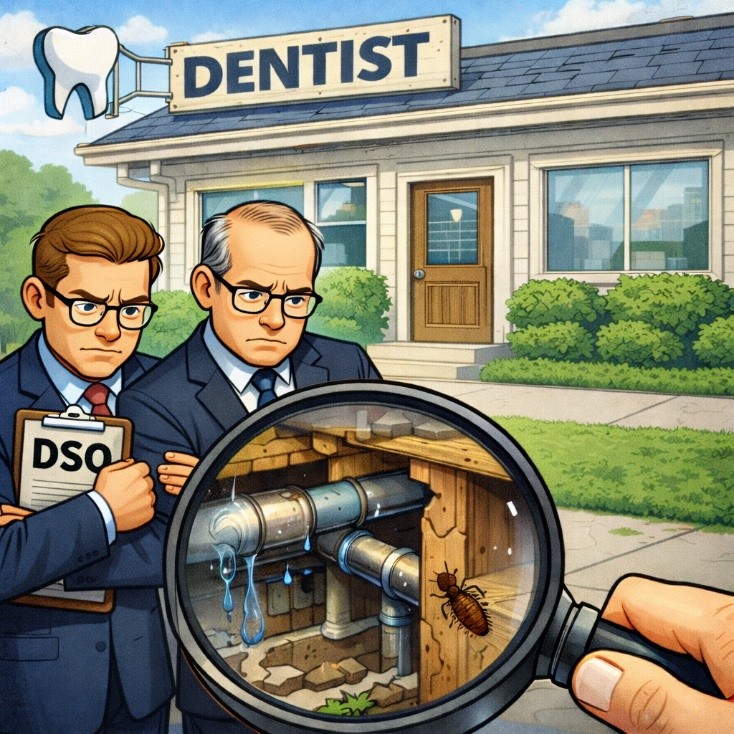
A DSO walks in and does something very different.
They don’t imagine what they could fix.
They observe what already exists.
And that distinction matters more than most dentists realize.
I’ve watched DSOs walk away from practices that dentists were eager to buy — practices that looked solid on the surface, practices with good production, practices with loyal patients, and long-standing teams. And I’ve watched them pursue practices that dentists would have overlooked entirely because they didn’t feel exciting.
The reason comes down to how DSOs read risk.
A dentist tends to evaluate a practice through the lens of capability. “Can I run this?” “Can I improve this?” “Can I produce here?” Those are natural questions. They’re also the wrong ones for acquisition.
A DSO is asking something else entirely: “How hard will this be to absorb?” “What friction will show up once we own it?” “What breaks when pressure is applied?”
They’re not looking for perfection. They’re looking for predictability.
One of the first things a DSO notices is how the practice behaves without the seller in the room. How decisions get made. How problems get handled. Whether there’s a rhythm to the day or constant improvisation. They can feel it almost immediately. You can sense when a practice runs on habits instead of structure, even if everything seems “fine.”
Dentists often miss this because they’re used to adapting. You’ve been adapting your entire career. You compensate instinctively. You step in when something goes sideways. You smooth things over. That ability makes you a great clinician and a strong owner, but it also blinds you to how fragile a practice can be when someone else has to step into it cold.
DSOs don’t assume they’ll adapt. They assume the practice needs to stand on its own.
They also pay close attention to how people behave when no one is watching. Team interactions. Hand-offs. Tone at the front desk. How questions get answered. Whether the same issues come up repeatedly. These things don’t show up on a profit-and-loss statement, but they show up quickly after acquisition, which is exactly why DSOs care so much.
Another thing dentists often miss is how much mental bandwidth an acquisition will require. A practice might look manageable on paper, but if it requires constant oversight, constant decision-making, constant course correction, a DSO sees that as a drag on the entire portfolio. Dentists tend to underestimate this because they assume effort is part of the deal. DSOs assume effort is a cost.
And then there’s integration.
Dentists rarely think about integration before they buy. They think about ownership. They think about control. They think about potential improvements. DSOs think about how seamlessly a practice will fit into what already exists. How fast it can align. How much resistance there will be. How many surprises will surface after the paperwork is signed.
A practice that looks “fine” but has deeply ingrained habits can be far more expensive to integrate than a practice that’s smaller, simpler, and more consistent. Dentists tend to equate size with value. DSOs often equate simplicity with scalability.
This is where the gap really shows.
A dentist might look at a practice and say, “I can make this better.”
A DSO looks at the same practice and says, “This will take longer than it’s worth.”
Neither is wrong. They’re just playing different games.
DSOs aren’t trying to prove they can improve a practice. They’re trying to protect the performance of everything they already own. That makes them far more conservative than most dentists expect. It also makes them far more selective.
If you’re a growth-minded dentist who wants to acquire, this doesn’t mean you need to become a DSO. But it does mean you need to borrow their lens.
You need to slow down your optimism.
You need to separate excitement from evidence.
You need to look past what you could do and focus on what the practice already does consistently, predictably, and without heroics.
That shift alone will change the kinds of opportunities you pursue. It will keep you from bringing home problems disguised as growth. And it will move you closer to acquisitions that actually add value instead of absorbing it.
In the next piece, we’ll talk about what happens when dentists don’t make this shift and why so many dentist-led acquisitions don’t fail dramatically, but quietly, slowly, and expensively.
For now, just remember this:
A practice can look good and still be the wrong acquisition.
DSOs know how to tell the difference.
To your success,
Your Team at Everything DSO
PS – For deeper insight into growth, acquisition, and exit strategy, you can subscribe to the Dental Growth & Exit Newsletter. Two months free to start.